
 IUX
IUX
 Exness
 Vantage
 XM
XM
 ICMarkets
 LiteFinance
 Moneta
 Tickmill
 South Africa (9)
 India (9)
 Bangladesh (12)
 Germany (9)
 Thailand (10)
 Philippines (9)
 Nigeria (10)
 Vietnam (10)
 Malaysia (9)





What’s Currency Pair in Trading?



Share:
Share:
Markets
7 min read

What is a currency pair?
If you are new to Forex trading, one of the first words you'll likely encounter will be currency pair.
A currency pair expresses the exchange rate between two different national currencies, and in a forex transaction, you always have to sell one currency while buying another one.
Each currency pair comprises:
- A Base Currency: This refers to the first currency in the pair. For example, EUR in EUR/USD.
- A Quote Currency: This is the second currency in the pair. For example, USD in EUR/USD.
If, for instance, the EUR/USD is trading at 1.2000, that means that 1 euro is equal to 1.20 U.S. Dollars.
Alright, now that you know what a currency pair is and how it works, let’s talk about something every trader should understand — the different types of currency pairs.
Not all pairs are created equal. Some are super popular and easy to trade, while others can be a bit more unpredictable but may offer bigger opportunities.
To keep things simple, we can group all currency pairs into three main types that you’ll come across in the Forex market.
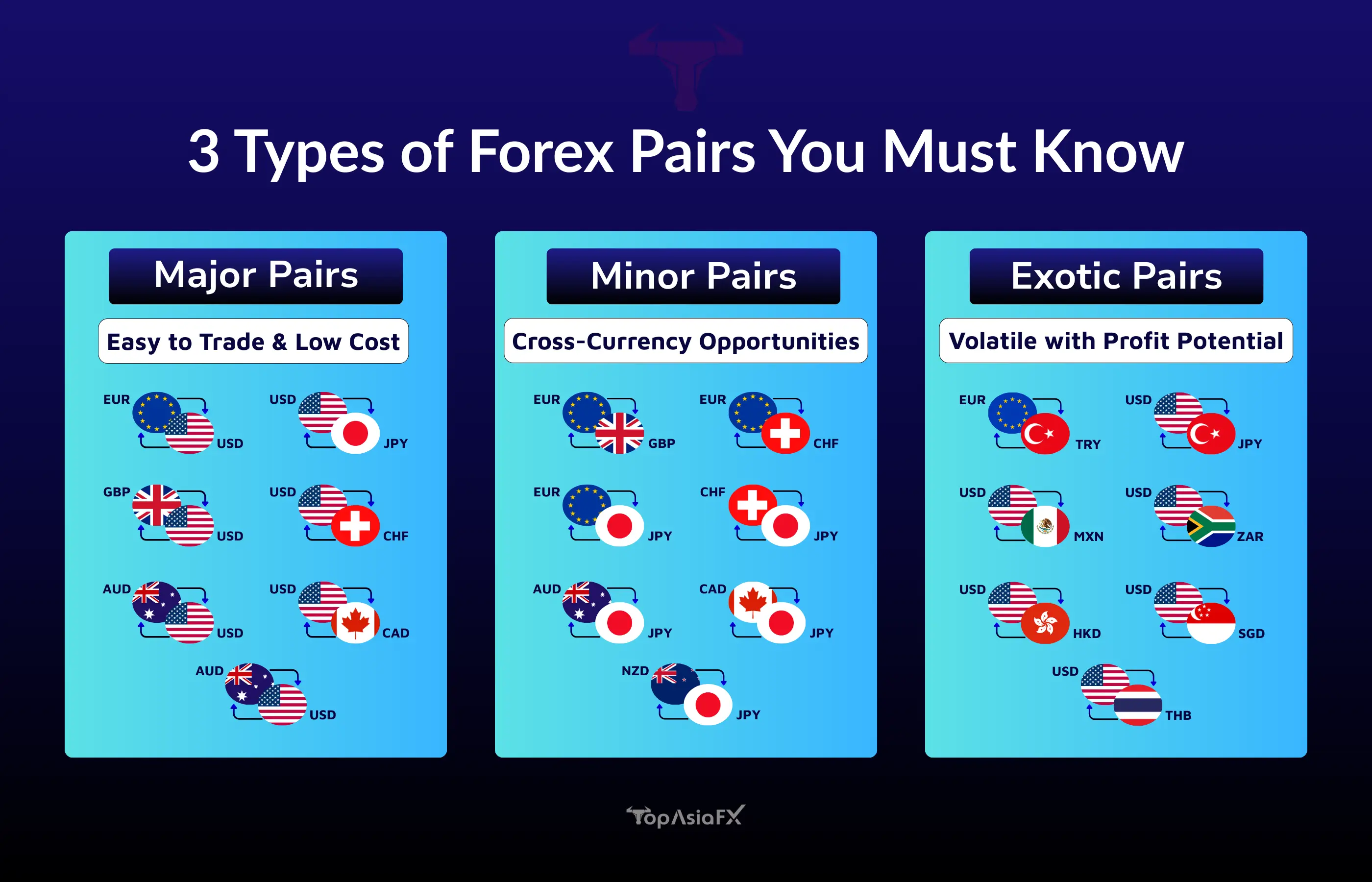
Major Currency Pairs
These include the most traded forex pairs. They contain currencies from the world's strongest economies.
As a matter of fact, major currency pairs make up about 50% of global forex trading volume.
Major pairs all include the US dollar (USD), and are very liquid pairs that are easy to trade with low transaction costs.
Examples of major currency pairs are as follows:
- EUR/USD: This is the most traded forex pair globally because it has very tight spreads and high liquidity.
- USD/JPY: This pair is popular for its stability and safe-haven appeal.
- GBP/USD: Also called "Cable," the GBP/USD pair is characterized by strong volatility and a variety of trading opportunities.
- USD/CHF: This pair is often considered a safe-haven currency.
(Overview of Major Currency Pairs)
Minor Currency Pairs
Minor currency pairs do not include the U.S. dollar as one of its two currencies, but rather involve other worthwhile currencies of major economy countries.
They have slightly lower liquidity than major pairs, but with decent volume of trading nonetheless.
What pairs fall into this category?
- EUR/GBP (Euro/British Pound), which is sometimes called “Chunnel,” implying the economic differences between the Eurozone and UK.
- GBP/JPY (British Pound/Japanese Yen) goes by the nickname “Guppy,” and is characterized by high volatility.
- EUR/JPY (Euro/Japanese Yen) is sometimes called “Yuppy” and offers good diversification possibilities.
There’s a third category which includes high risk currencies that can provide big profits for traders. Would you say this feels like you?
Let’s find out.
Exotic Currency Pairs
Exotic currency pairs are made up of one major currency and another from a developing or smaller economy.
They usually exhibit higher volatility, with wider spreads and lower liquidity.
A few examples of exotic currency pairs include:
- USD/TRY (US Dollar/Turkish Lira)
- EUR/ZAR (Euro/South African Rand)
- USD/SGD (US Dollar/Singapore Dollar)
(Overview of Exotic Currency Pairs)
These aren’t all though.
There are two more categories of currency pairs that are definitely worth your while.
Forex Cross Pairs and Commodity Pairs
Cross Currency Pairs
Cross currency pairs are those that exclude the U.S. Dollar, thus allowing traders to make a direct exchange between any two major currencies.
That is: EUR/JPY, GBP/AUD, or CHF/JPY, for example.
The cross pairs may seem similar in theory to the minor pairs, but they aren’t.
Here’s a quick side-by-side comparison.
| Cross Pairs | Minor Pairs |
|---|---|
| These are any Forex pairs that do not include the US dollar. | These pairs also exclude USD. |
| In other words, cross pairs allow the trader to transact one major currency for another directly without converting into USD. | Minor pairs are those whereby at least one is a currency among the world’s most major currencies; for example, EUR, GBP, JPY, and many others. |
| The best examples for this are EUR/JPY and GBP/AUD, among many others. | What this means is that all minor pairs are cross pairs, but not all cross pairs can be categorized as minor. |
Commodity Currency Pairs
Pairs within this category require traders to closely monitor commodity prices as they invest.
Certain currencies are tightly linked to commodity prices because they are from the countries that export raw materials such as oil, gold, and natural gas.
The economic data from these countries matter a lot to traders investing in commodity pairs.
For example,
- USD/CAD (US Dollar/Canadian Dollar): As Canada is a major oil exporter, this currency pair is influenced by crude oil prices.
- AUD/USD (Australian Dollar/US Dollar): The Australian economy is linked to commodities such as gold and coal.
- NZD/USD (New Zealand Dollar/US Dollar): This pair usually moves in tandem with dairy and agricultural exports.
Now that’s all said and done. How can traders make money from currency trading? What are the secrets behind it?
How to Profit From Currency Pair Trading?
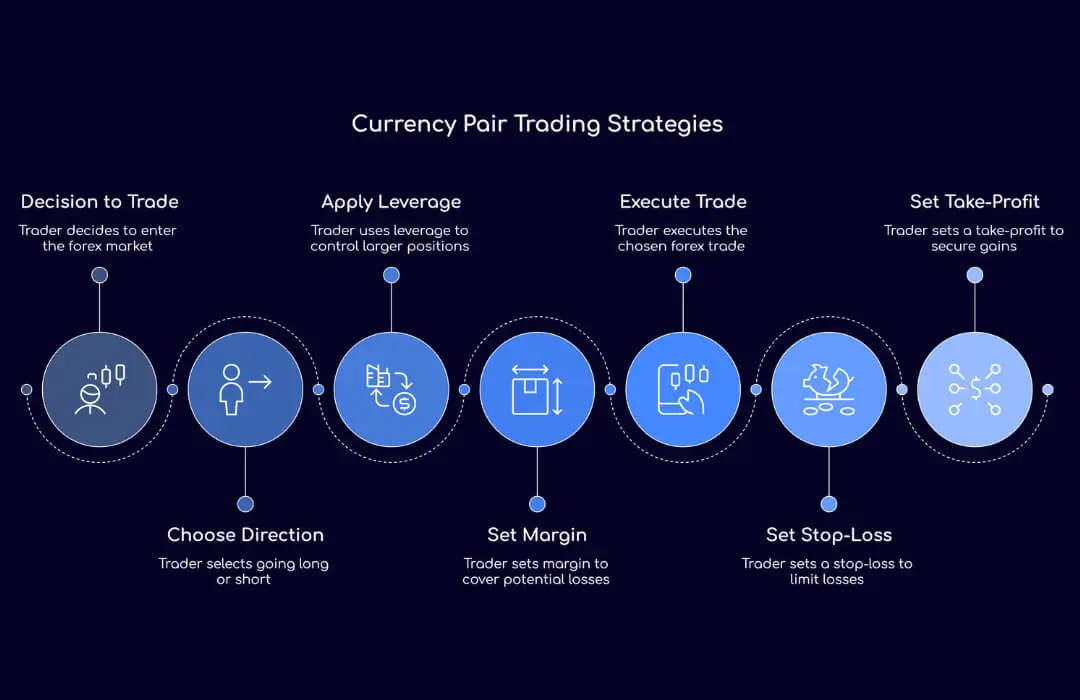
There are many opportunities to profit in currency pair trading in forex. However, you need to plan and apply the right strategies.
Allow me to show you how:
Going Long vs. Going Short
Traders can choose to go long (buy) or go short (sell) when trading forex, depending on their prediction of market direction.
Going long refers to when the trader buys the base currency with an expectation that it will rise in value against the quote currency.
For example: If Ken buys the EUR/USD at 1.2000 and it rises to 1.2200, his profit comes from the increase in the price.
Going short is when the trader sells the base currency in hopes that it will diminish in value against the quote currency.
For instance: If Ken sells GBP/USD at 1.3000 and it drops to 1.2800, he profits by virtue of the price decline.
Using Leverage and Margin
I believe the greatest benefit of forex trading is the leverage that allows a trader to control a larger position by using less of their capital to invest.
Leverage is an expression of a ratio. For instance, 100:1 means that for $100 in your account, you can control a worth of $10,000 worth of currency. Read more about leverage and margin.
Meanwhile, margin refers to the amount of funds that is always floating in a trader’s account to keep a trade active.
It is a deposit paid to ensure the account can cover potential losses for each trade.
Yet while high leverage magnifies profit opportunities, it also elevates risk, such that a small adverse market movement can produce debilitating losses.
Stop-Loss and Take-Profit Orders
Stop-loss and take-profit orders are methods through which a trader can effectively control risk.
A stop-loss automatically closes a trade when the price hits a certain level, so that potential losses can be limited. Learn more about stop-loss and take-profit.
Here’s an example for context. If Bebe goes long on USD/JPY at 150.00, she can set a stop-loss at 149.50 to cap her loss.
On the other side of the same coin is a take-profit. With a take-profit, a trade will close automatically if it reaches a specified price level. This way, the trader can lock in their intended profits just before the market reverses.
For instance, Bebe buys GBP/USD at 1.2500 and expects it to rise, she can set a take-profit at 1.2700 in order to lock in her gains.
Conclusion
Currency pair trading is a great way to invest in the global markets through Forex. Whether you’re trading major, minor, or exotic pairs, understanding market structure and liquidity is crucial.
I recommend starting small, practicing risk management, and refining your strategies over time. Happy trading!
Other Useful Links for Deeper Learning
F. Nathan
Felix Nathan is a professional trader, market analyst, and business development executive with over a decade of experience in the forex and financial markets. Felix specializes in providing actionable market insights, trading strategies, and risk man...